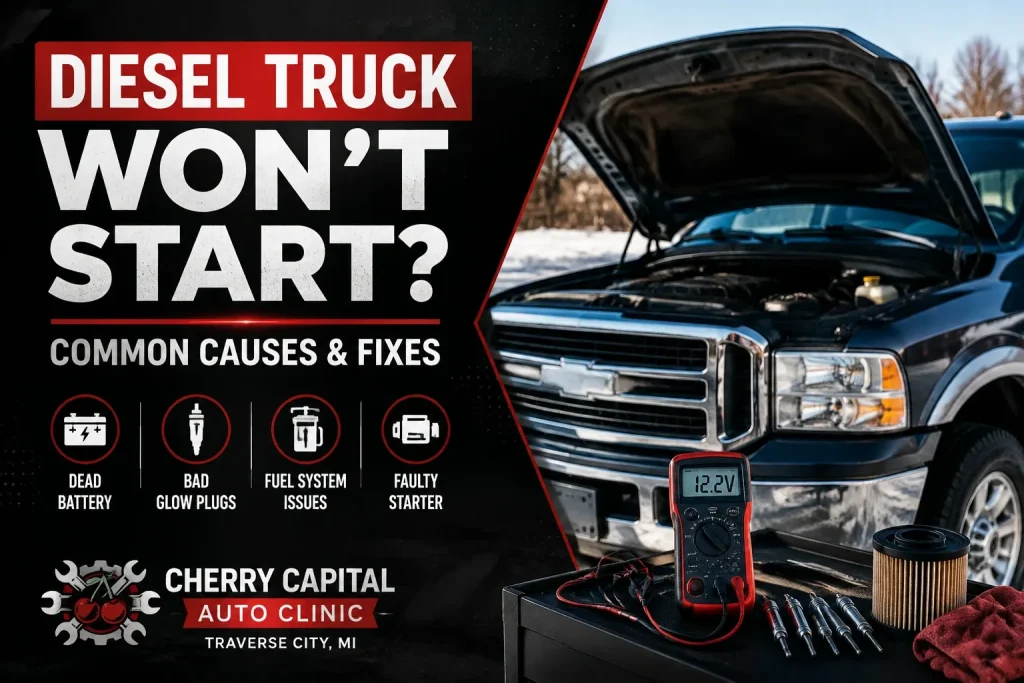
There’s nothing quite as frustrating as turning the key on your diesel truck and hearing nothing but a click or worse, complete silence. Whether you’re heading out to work in Traverse City or just trying to get the kids to school, a diesel truck that won’t start can throw off your entire day.
The good news is that most no-start problems come down to a short list of usual suspects: the battery, the glow plug system, the fuel system, or the starter. Diesel engines rely on high compression and precisely timed fuel delivery to fire; unlike gas engines, they don’t use spark plugs, so the failure points are a little different. Once you know what to check, you can often narrow down the cause before you ever call a mechanic.
In this guide, we’ll walk through the most common reasons a diesel truck won’t start, how to tell them apart, and what it takes to get you back on the road. If you’re in Northern Michigan and need a hand, our ASE-certified diesel technicians at Cherry Capital Auto Clinic diagnose and repair diesel no-start issues every week.
Why Diesel Engines Are Different When They Won’t Start
Diesel engines don’t use spark plugs to ignite fuel. Instead, they compress air until it’s hot enough to ignite diesel fuel on contact. That means a no-start problem is almost always related to one of three systems:
- Electrical system – battery, starter, wiring, or the ECM
- Fuel system – fuel delivery, filtration, or fuel quality
- Glow plug/compression system – the components that help diesel engines start, especially in cold weather
Understanding which of these three systems is failing is the fastest way to diagnose the problem, so let’s break each one down.
1. Dead or Weak Battery
This is, by far, the most common reason any vehicle, gas or diesel, won’t start. Diesel engines need significantly more cranking power than gasoline engines because of their high compression ratios, which means a battery that’s just a little weak may start a gas car but fail to turn over a diesel.
Signs your battery is the problem:
A single click when you turn the key, then nothing
Dashboard lights are dim or flicker
The engine cranks slowly, almost like it’s “dragging”
Battery is more than 3–4 years old
Diesel trucks often run dual batteries wired together, so if one battery is weak, it can drag down the whole system even if the other is healthy. Corroded terminals, loose connections, and parasitic drains (like an interior light left on) are also common culprits.
The fix: Test the battery’s voltage and cold cranking amps. A reading under 12.4 volts at rest usually signals a battery that needs charging or replacing. We cover the exact warning signs to watch for in our post on car battery replacement signs; they apply just as much to diesel trucks as to daily drivers.
2. Faulty Glow Plugs or Glow Plug Relay
Glow plugs heat the combustion chamber before startup so the diesel fuel ignites properly, especially in cold or cool weather. If one or more glow plugs fail, or the relay/controller that powers them goes bad, your truck may crank fine but refuse to actually fire up.
Signs of a glow plug problem:
Long cranking time before the engine catches
“Wait to Start” light stays on longer than usual, or never turns off
Rough idle right after starting, which smooths out once warm
Truck starts fine in warm weather but struggles in the cold
Glow plugs are a wear item, and it’s common for one or two to fail before the rest. Since Northern Michigan winters are no joke, a truck running on a couple of dead glow plugs might start fine in August and refuse to start in a November cold snap.
The fix: A technician can test each glow plug’s resistance individually and check the relay and wiring harness. Replacing a full set of glow plugs is a routine job and one of the more affordable fixes on this list.
3. Fuel Delivery Problems
If your truck cranks strong but never catches, the issue is very often fuel-related rather than electrical. Diesel fuel systems are sensitive to air, contamination, and cold temperatures in Michigan winters.
Clogged Fuel Filter
Diesel fuel filters trap water and debris, but over time they get clogged, restricting fuel flow to the injectors. A clogged filter often causes hesitation or stalling before it causes a full no-start, so if your truck has been running rough lately, this is worth checking first.
Air in the Fuel Lines
Diesel fuel systems need to stay primed. If you recently changed a fuel filter, ran the tank low, or had a fuel line disconnected for any repair, air can get trapped in the lines and prevent the engine from building the pressure it needs to fire.
Gelled Fuel (Cold Weather)
When temperatures drop, diesel fuel can start to gel; the paraffin wax naturally present in diesel fuel thickens and clogs the filter and fuel lines. This is one of the most common cold-weather, no-start complaints we see once temperatures dip below freezing here in Traverse City.
Signs of a fuel problem:
Engine cranks normally but won’t catch
Truck ran fine, then suddenly wouldn’t start after refueling
White smoke or a strong diesel smell during cranking
No-start happens specifically after a cold night
The fix: A clogged filter needs replacement, air in the lines needs to be bled out properly, and gelled fuel typically requires warming the truck (often in a heated bay) along with an anti-gel additive before the next fill-up. Using a winter-blend diesel fuel from November through March goes a long way toward preventing this in Michigan.
4. Starter Motor Issues
If you turn the key and hear a single loud click or nothing at all, even with a known-good battery, the starter motor itself may be failing. The starter has to work harder on a diesel engine than a gas engine because of the extra compression it’s fighting against, which means starters on diesel trucks tend to wear out faster.
Signs of a failing starter:
Clicking sound, but the engine doesn’t crank
Starter engages, but the engine doesn’t turn over (grinding noise)
Starting works intermittently, especially after the engine is warm
Smoke or a burning smell near the starter after attempted starts
The fix: A worn starter motor, solenoid, or damaged flywheel teeth will need replacement. This is a bigger job than a battery swap, but it’s usually straightforward for an experienced diesel technician.
5. Fuel Injector or Injection Pump Failure
Less common, but more serious, is a failure in the fuel injectors or the injection pump itself. If injectors aren’t delivering fuel at the right pressure and timing, the engine may crank endlessly without starting, or start briefly and immediately die.
Signs of injector or pump trouble:
Truck cranks for an unusually long time
Engine starts and dies right away
Check Engine light with fuel-pressure-related codes
Noticeable loss of power in the days leading up to the no-start
The fix: This requires diagnostic scanning and fuel pressure testing to pinpoint whether it’s a single injector, the whole set, or the pump. It’s a more involved repair, so an accurate diagnosis up front saves you from replacing parts that weren’t actually the problem.
6. Security System or ECM Glitch
Modern diesel trucks run on computer-controlled engine management systems. Occasionally, a no-start is caused by a security system fault (like a key fob or immobilizer issue) or an ECM (engine control module) glitch rather than a mechanical failure at all.
Signs of an electronic issue:
Dashboard warning lights behave strangely, or all illuminate at once
Truck won’t start with one key but starts with a spare
No-start happened right after a battery disconnect or electrical work
The fix: This calls for a diagnostic scan tool to read stored fault codes and pull up the truck’s actual electronic history, not guesswork.
Won’t Crank vs. Cranks But Won’t Start: Quick Diagnostic Guide
| Symptom | Likely Cause |
| No sound at all when turning the key | Dead battery, bad ground connection |
| Single click, no crank | Weak battery or failing starter solenoid |
| Cranks slowly | Weak battery, cold weather, thick oil |
| Cranks strong but won’t catch | Fuel delivery issue, air in lines, glow plugs |
| Starts then immediately dies | Fuel pressure or injector issue |
| Only fails in cold weather | Glow plugs, gelled fuel, battery cold-cranking capacity |
| Won’t start with one key, fine with another | Security system/immobilizer fault |
Preventing Diesel No-Start Problems
Most diesel no-start situations are preventable with routine maintenance rather than sudden failures. A few habits go a long way:
Have your battery and charging system tested each fall, before cold weather sets in
Switch to winter-blend diesel fuel before temperatures drop
Replace fuel filters on the manufacturer’s recommended schedule
Don’t let the fuel tank run low, especially in winter; condensation and gelling risk both go up
Address rough starts or long cranking times early, before they become full no-starts
We go into more detail on why staying ahead of small issues saves money in the long run in our article on how preventive maintenance saves you money. For diesel trucks specifically, a seasonal inspection before winter is one of the best investments you can make.
When to Call a Professional
A basic jump-start or battery swap is something most truck owners can handle themselves. But if you’ve ruled out the battery and the truck still won’t start, or the problem keeps coming back, it’s time to bring in a diagnostic tool and a trained eye. Chasing a fuel delivery or injector problem without the right equipment often leads to replacing parts that weren’t actually broken, which costs more in the end.
At Cherry Capital Auto Clinic, our technicians work on gas, diesel, and electric vehicles under one roof, and diesel fuel systems, glow plug diagnostics, and starter replacement are all part of our everyday work on the diesel truck repair page. Every repair we perform is backed by a written 12-month warranty, so you’re covered if anything comes up after you leave.
Frequently Asked Questions
Why does my diesel truck only fail to start in cold weather?
Cold weather affects diesel trucks more than gas vehicles because thick, cold oil makes cranking harder, batteries lose cranking power in low temperatures, glow plugs have to work harder to heat the combustion chamber, and diesel fuel itself can begin to gel below certain temperatures.
Can I jump-start a diesel truck like a gas vehicle?
Yes, but diesel trucks draw significantly more current, so you’ll want jumper cables rated for heavy-duty use and, ideally, a set of jumper batteries or a jump box built for diesel engines rather than a small portable unit.
How long can glow plugs last before they need replacement?
Glow plugs typically last 80,000–100,000 miles, but individual plugs can fail earlier, especially if the truck sees a lot of short trips or cold-weather starts.
Is it bad to keep cranking a diesel truck that won’t start?
Yes, repeated cranking without success can drain the battery further, overheat the starter motor, and in fuel-related cases, flood the engine. If it doesn’t start within a few attempts, it’s better to stop and diagnose the cause.
What does it cost to diagnose a diesel no-start problem?
Cost varies depending on the suspected cause, from a quick battery test to a full fuel-system diagnostic. You can see our current service pricing or give us a call for an estimate specific to your truck.
Get Your Diesel Truck Back on the Road
A diesel truck that won’t start is inconvenient, but it’s rarely a mystery once you know what to check. From a simple weak battery to a more involved fuel system issue, most causes have a clear fix, and most are preventable with the right maintenance schedule.
If your diesel truck won’t start and you’re in the Traverse City area, schedule a diagnostic appointment with Cherry Capital Auto Clinic. We’re a family-owned shop with state-certified master mechanics who work on diesel trucks every day, and every repair comes with a written 12-month warranty. Call us at 231-642-5033 or stop by 712 S Garfield Ave, Traverse City, MI 49686.