If you drive an electric vehicle, the battery pack isn’t just a component. It’s the single most expensive part of your car, and it’s the thing that quietly determines your range, your resale value, and how reliable your daily drive feels. Unlike a gas engine, where a rattle or a warning light gives you some notice that something’s wrong, EV battery wear tends to happen gradually and out of sight. Most drivers don’t really notice until their range has already dropped enough to be inconvenient.
That’s what an EV battery health check is for. A proper health check gives you an honest picture of how your battery is aging, whether it’s performing the way it should for its age and mileage, and whether anything needs attention now before it turns into a much bigger repair later.
Here in Northern Michigan, there’s an extra wrinkle EV owners in warmer states don’t have to think about as much: cold weather changes how a battery performs and charges, and it’s easy to mistake that seasonal dip for actual degradation. In this guide, we’ll walk through what a battery health check really involves, the warning signs that mean you shouldn’t wait for your next scheduled visit, and how Traverse City winters factor into the picture.
Why EV Battery Health Actually Matters
An EV battery pack is made up of hundreds, sometimes thousands, of individual cells working together. Over time and through repeated charge cycles, those cells naturally lose a small amount of capacity, and that’s expected. What you really want to catch early is degradation that isn’t normal: cells aging unevenly, a cooling system that isn’t pulling its weight, or a battery management system that’s lost the ability to keep everything balanced.
Left unchecked, problems like these tend to show up as reduced driving range, charging that gets slower or less consistent, noticeably weaker acceleration, and a real hit to your trade-in value when it comes time to sell. In the more serious cases, an imbalanced or overheating pack can even become a safety concern. A battery health check exists to catch these things while they’re still small and inexpensive to address, long before they turn into a full pack replacement, which is about the costliest repair an EV owner can face.
What Actually Happens During an EV Battery Health Check
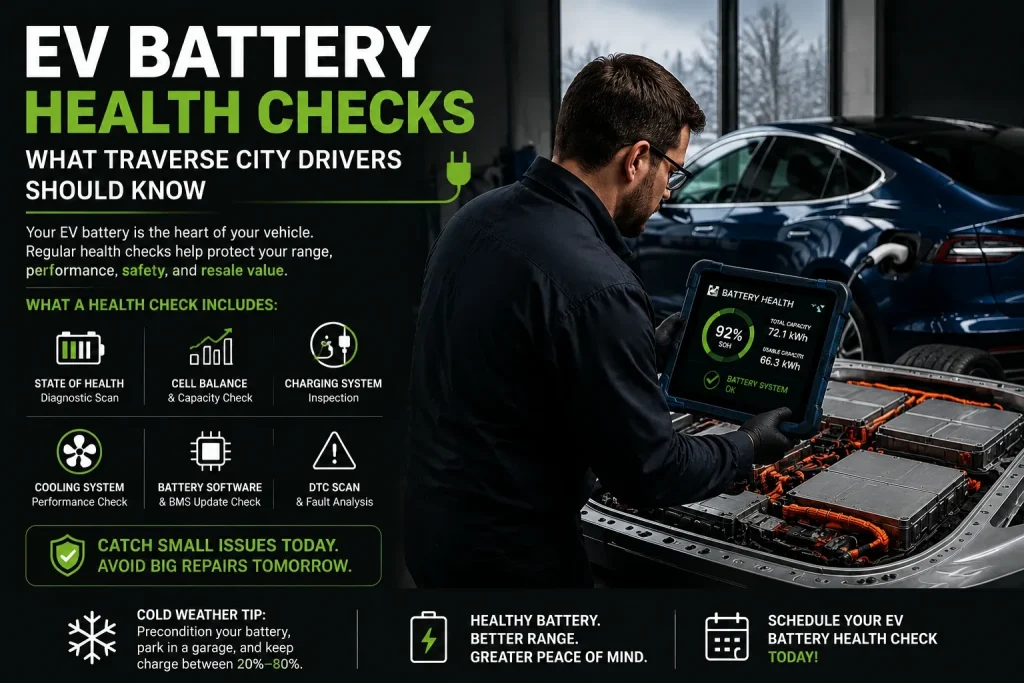
A thorough health check goes well beyond glancing at the range estimate on your dashboard. When it’s done properly, a technician works through several layers of the system.
It starts with a state of health diagnostic scan, where manufacturer-level equipment pulls the battery’s actual usable capacity directly from the battery management system and compares it to the pack’s original capacity when new. This gives a far more accurate read than trusting the dashboard’s range guess, which shifts with driving style and weather.
From there, a cell balance check looks at whether individual cells or modules are aging at different rates. Even a few weak cells can drag down the performance of an otherwise healthy pack, and this is one of the easier things to miss without the right tools.
The charging system itself gets inspected too, including the onboard charger, the charging port, and the wiring and connectors around them. A fault in this area can look exactly like a battery problem, slow or inconsistent charging, even when the battery is perfectly fine underneath it.
Because most EV batteries rely on liquid cooling to stay in their ideal temperature range, the cooling system gets checked as well. A weak coolant pump, low coolant level, or a partially blocked line can quietly accelerate battery wear, especially during fast charging or hot summer driving.
Technicians will also check for outdated battery management software, since manufacturers regularly release updates that improve charging efficiency and thermal management, and an outdated system can sometimes mimic symptoms of hardware wear that a simple update actually resolves. Finally, a scan for stored diagnostic trouble codes often reveals developing issues that haven’t triggered a dashboard warning yet but are worth addressing early.
Signs Your EV Battery Needs Attention Sooner Than Your Next Visit
You don’t have to wait for a scheduled appointment if something feels off. If your range is dropping faster than it used to, beyond the normal seasonal swing, that’s worth a look. The same goes for charging that’s noticeably slower than before, especially if you’ve noticed it at DC fast chargers where speed differences are hard to miss. Charging that stops on its own before reaching your target percentage, reduced power or hesitation under acceleration, unusual warmth near the pack or charging port after driving, or an actual battery warning light on the dash are all reasons to get things looked at rather than wait it out.
How Cold Michigan Winters Affect EV Batteries
Traverse City drivers deal with a real seasonal factor that shouldn’t be confused with battery failure. Lithium-ion batteries are simply less efficient chemically in cold temperatures, and your EV also spends energy heating the cabin and warming the battery pack before fast charging, both of which eat into range. Seeing a noticeable dip in the winter compared to summer is completely normal.
A few habits help soften that seasonal hit. Preconditioning the battery while it’s still plugged in, before you head out into the cold, makes a real difference. Parking in a garage, even an unheated one, helps reduce the temperature swings your battery has to deal with. It also helps to avoid letting the battery sit at a very low charge in freezing temperatures for long stretches, and using scheduled charging so the car finishes right before you plan to drive rather than sitting fully charged in the cold for hours.
If your winter range loss feels far beyond what’s typical for your specific model, that’s a good sign it’s time for a health check rather than chalking it up to the weather.
How Often You Should Get One
Most manufacturers suggest a battery health check on roughly the same schedule as your other major service intervals, generally once a year, or sooner if you’ve noticed any of the warning signs above. If you’re planning to sell or trade in your EV, a recent battery health report is also one of the most valuable things you can hand a buyer, since battery condition affects EV resale value even more than mileage does.
Routine health checks fit naturally into the rest of your regular maintenance schedule. We talk more broadly about why staying ahead of small issues pays off over time in our article on how preventive maintenance saves you money, and the same thinking applies directly to how you should treat your EV’s battery.
Don’t Confuse the Main Battery With the 12 Volt Battery
Here’s something that trips up a lot of EV owners. Your electric vehicle actually carries two batteries, not one. The large lithium-ion pack powers the drivetrain, but nearly every EV also has a small 12-volt battery that runs the electronics, the infotainment system, and other low-voltage functions, the same type of battery you’d find under the hood of a gas car.
If your EV won’t power on or starts throwing odd electrical glitches, that smaller 12-volt battery is very often the actual cause, not the main pack. The warning signs look a lot like what we cover in our guide to car battery replacement signs: dim electronics, a sluggish power up, or a display that won’t come on at all. It’s worth ruling that out before assuming the worst about your main battery.
Choosing a Shop That Actually Knows EVs
Not every repair shop is set up to properly diagnose high-voltage EV battery systems. It takes specific training, safety protocols, and manufacturer-level diagnostic tools that a lot of general shops simply don’t have. When you’re choosing where to take your EV, it’s worth asking whether their technicians are specifically trained on high-voltage systems, whether they use manufacturer diagnostic software rather than a generic code reader, whether they work on EVs regularly rather than occasionally, and whether you’ll actually get clear, understandable findings rather than a vague pass or fail.
At Cherry Capital Auto Clinic, EV diagnostics and repair are part of our everyday work right alongside gas and diesel vehicles, covered on our EV service page. Every repair we perform, including EV battery and charging system work, is backed by a written 12-month warranty.
Frequently Asked Questions
Is EV battery degradation normal?
Yes. Some gradual capacity loss is expected over the life of any lithium-ion battery, typically a small percentage each year under normal use. What matters is whether that degradation is happening at a normal pace or faster than expected, which is exactly what a health check is meant to measure.
Can cold weather permanently damage an EV battery?
Normal cold weather range loss is temporary and reverses once temperatures warm back up. That said, repeatedly charging or storing a battery at very low temperatures, particularly at very high or very low charge levels, can contribute to faster long-term degradation.
How much does an EV battery health check cost?
Cost depends on the vehicle and what the inspection covers. You can find our current service pricing on our pricing page, or give us a call for an estimate specific to your make and model.
Does fast charging wear out the battery faster than home charging?
Frequent DC fast charging does generate more heat and can contribute to slightly faster degradation over time compared to Level 2 home charging, but modern EVs are engineered with this in mind. Occasional fast charging isn’t something to worry about. It’s a steady diet of it without adequate cooling that tends to matter more.
What’s the difference between a battery health check and a regular EV service?
A general EV service usually covers tires, brakes, cabin filters, and fluid checks, essentially the EV equivalent of routine maintenance. A battery health check specifically targets the high-voltage battery pack, its cooling system, and its charging performance, and it typically requires specialized diagnostic equipment that a general service visit doesn’t use.
Schedule Your EV Battery Health Check in Traverse City
Your EV’s battery is too important and too expensive to leave to guesswork. A yearly health check gives you real data on how your battery is actually aging, catches small issues while they’re still cheap to fix, and gives you some peace of mind heading into another Northern Michigan winter.
If it’s been a while since your last check, or you’ve noticed any change in your range or charging, schedule an appointment with Cherry Capital Auto Clinic. We’re a family-owned shop serving Traverse City and the surrounding area, staffed by state-certified master mechanics trained across gas, diesel, and electric vehicles. Call us at 231-642-5033 or stop by 712 S Garfield Ave, Traverse City, MI 49686.